
Can I tell you something I hear almost every week? A therapist reaches out, smart, incredibly skilled, doing genuinely important work, and their website looks like it was built in 2014 during a free trial of something.
The copy is vague. The colors feel random. And I can’t tell within five seconds who they help or how to book with them.
I’m not saying this to be mean. I’m saying it because your therapist website is literally the first thing a potential client sees before they decide whether to trust you with some of the hardest stuff in their life.
That’s a lot of pressure to put on a homepage that just says “Welcome! I’m passionate about helping people.”
Dude, c’mon. We can do better.

Here’s what a well-designed website for your therapy private practice actually does: it shows up in search results when someone is in a hard moment and Googling “trauma therapist near me” or “weight-inclusive therapist who gets it.” It tells that person within seconds whether they’re in the right place. And it either makes it easy to reach out, or it makes them click away to someone else.
A generic template from a website builder can technically do some of this. But it can’t do it well for you, specifically, the way a custom therapy website can.
And if your practice is weight-inclusive or trauma-informed? That matters even more. Your clients have likely had experiences with providers who didn’t understand them. Your website has to communicate that you’re different before they ever fill out a contact form.
Trust is everything in mental health.
And your website is where that trust either starts or doesn’t. Potential clients are Googling you before they ever reach out, they’re reading your bio, looking at your credentials, getting a feel for your approach. If your site looks outdated, unclear, or just kind of thrown together, that’s the impression they’re carrying into their decision.
A professional therapist website gives you the space to actually show who you are, your training, your specializations, your philosophy, the way you show up for clients. That’s not just nice to have. That’s your credibility on the page. A custom site lets you control that narrative completely, in a way that a generic Wix template with stock photos of people sitting across from each other in armchairs simply cannot do.
And I’ll say it plainly: your clients are specifically looking for someone who gets their experience. Showcasing your credentials and approach clearly and intentionally isn’t bragging. It’s how they know they’re in the right place.
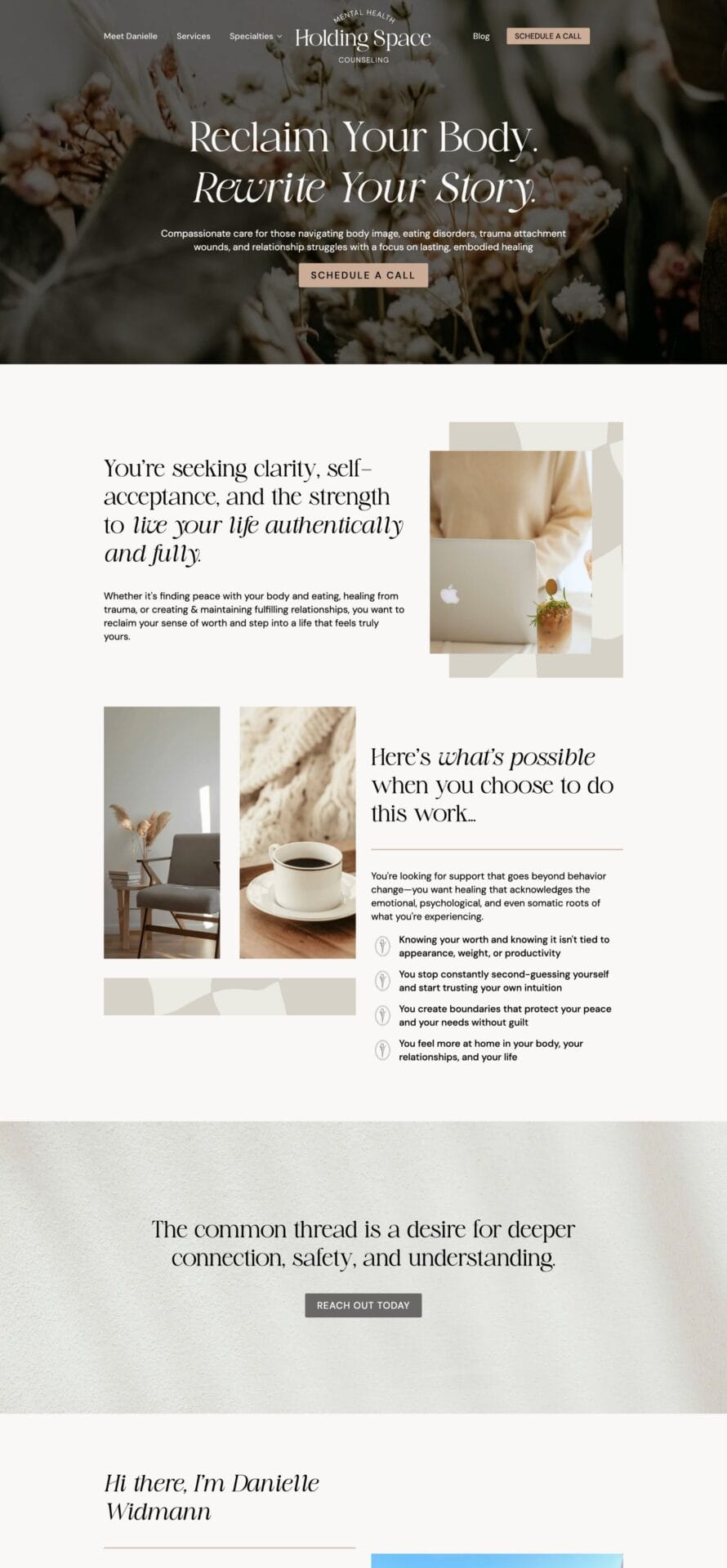
A custom website we built for Danielle at Holding Space Mental Health Counseling
I work almost exclusively with weight-inclusive practitioners, so I’ve seen this play out a lot. When someone has struggled to find a provider who actually respects their body, or who understands the intersection of food, trauma, and mental health, they’re not just casually browsing. They are searching desperately for the right fit. They’re reading every word on your About page. They’re picking up on whether your site feels safe or whether it’s covered in stock images of salads and people jumping in the air.
Your weight-inclusive therapy website should feel like a breath of fresh air to the exact people you’re trying to reach. That means the language, the visuals, the overall vibe, all of it needs to be intentional. A custom website for your mental health practice lets you actually build that. A template? It’s going to fight you the whole way.
For trauma-informed therapists especially, the online experience you create matters more than you might think. Someone who has experienced trauma or weight stigma is not going to take risks with a provider whose website doesn’t feel specifically safe and welcoming to them. Thoughtful design and carefully chosen language aren’t just aesthetic choices, they’re how you communicate, before a single session ever happens, that your practice is a different kind of place.
A custom site also lets you put your specializations front and center in a way that helps with SEO. If you’re a trauma-informed eating disorder therapist in Atlanta, that needs to be clear and specific, not buried in paragraph four on your About page that search engines can barely parse.
Okay, I know what you might be thinking, “I can’t share client information, so how do I prove my work?” And you’re right, client confidentiality is everything. But there’s still a lot you can share. How many years you’ve been practicing. Continuing education and advanced trainings you’ve completed. Frameworks or modalities you’re certified in. Even aggregate data about client outcomes (done carefully and ethically) can go a long way.
When you weave this kind of information into your private practice website, clearly and accessibly, not buried in a wall of text, it does something really important: it helps potential clients who are on the fence feel more confident in choosing you. Numbers and specifics cut through vague claims. “I’m passionate about helping people heal their relationship with food” hits differently when it’s backed up by “certified in EMDR, trained in intuitive eating, and working with eating disorder clients for over 10 years.” Both matter. Use them.
I love a good stat, so here’s one: 55% of visitors spend fewer than 15 seconds on a page. And mobile users are five times more likely to leave a site that isn’t mobile-friendly. Five times. So when I say that how your site is designed matters as much as what it says, I mean it.
Good web design for therapy websites isn’t about having the prettiest color palette (though honestly, that matters too). It’s about making sure that when someone lands on your homepage, they immediately know what you do, who you help, and what to do next. Clear navigation. A strong above-the-fold statement that says exactly what you offer. High-quality images that actually reflect the vibe of your practice, not just whatever came up first in a free stock photo search.
And then there’s mobile. If I pull up your website on my phone and I have to pinch and zoom to read your bio or the contact button is half off the screen — I’m gone. Your potential clients are too. A custom site is built to look intentional and function flawlessly across every device, because that’s not optional anymore.
Let me just say it plainly: if someone in your city searches for “HAES therapist” or “trauma-informed eating disorder counselor [your city],” you want your private practice website to show up. That doesn’t happen by accident, and it doesn’t happen with a five-page template that hasn’t been touched since it launched.
Local SEO for therapists starts with the foundation of your site, the right page structure, location-specific content woven in naturally, and a properly claimed and optimized Google Business Profile. It also means getting your practice listed accurately across online directories, and ideally collecting genuine client reviews over time. None of this is magic. It’s just consistent, strategic effort built on a solid website foundation.
And here’s the thing I cannot say enough: you cannot SEO your way out of a branding problem. If your website is confusing, slow, or doesn’t clearly communicate who you help, getting more traffic to it just means more confused people bouncing right off. The foundation has to be solid first. #funnybuttrue
This is the part that surprises a lot of people. Your domain name, that web address people type in to find you, is actually a small but real factor in your overall SEO strategy, and it’s definitely a big factor in first impressions.
If you can include relevant keywords or your location in your domain, that can work in your favor. Think something like ATLTraumaTherapist.com or EatingDisorderCounselorDenver.com, those tell both Google and potential clients exactly what you do and where you do it, right from the jump. That said, your name or practice name works perfectly fine too, especially if you’re building long-term brand recognition. The point is to choose intentionally, not just grab whatever’s available and call it a day.
You’d be amazed how many therapy practice websites make it weirdly hard to actually book a consultation. The contact form is buried on a page that takes four clicks to find. The scheduling link is broken. There’s zero clarity on what happens after someone fills out the form. For someone who is already anxious about asking for help, which is most therapy clients friction at the booking stage is the difference between them following through and them closing the tab.
A custom website lets you integrate your scheduler in a way that actually works, loads fast, and is mobile-friendly. The call to action should be obvious. The next step should be clear. Making it easy for someone to book isn’t just a nice client experience, it’s directly tied to your conversion rate. The click-to-client experience matters at every single stage.
Your website doesn’t have to be a static brochure that just sits there. One of the most underutilized opportunities I see with therapist websites is the blog, or lack thereof. Sharing your perspective on topics relevant to your specialty (eating disorder recovery, HAES, trauma, body image, etc.) does something really important: it positions you as a trusted voice in your community, not just a practitioner with an available slot.
This kind of content also helps with SEO in a big way. Every well-written, relevant blog post is another opportunity to show up in search results for the people you’re trying to reach. And beyond Google? It gives potential clients more of a sense of who you are before they ever reach out. Connecting with local organizations, other aligned practitioners, and relevant online communities adds to that too. It all compounds over time.
Okay, I’ll be real with you: a template-based site isn’t always the wrong answer. If you’re brand new, pre-clients, and you genuinely cannot invest in a custom therapy website right now, something is better than nothing, get yourself a basic presence, full stop. But if you’ve been in practice for a while, you have a clear specialty, and you’re serious about growing your caseload, a generic template is going to cap what your website can actually do for you.
Custom website design for therapists means your site is built around your specific brand, your specific clients, and your specific goals. The SEO foundation is solid from the start. It doesn’t look like forty other therapist websites using the same Squarespace template with slightly different font colors. And your ideal clients, the ones who need a weight-inclusive, trauma-informed, HAES-aligned therapist, will feel it when they land on your page.
Yes, custom costs more upfront. But the long-term ROI, in time saved, in better-fit clients, in a site that actually converts, almost always makes it worth it. You’re not just buying a website. You’re buying a strategic tool that works for your practice while you’re busy doing the actual work.
I’ve seen it happen so many times. Someone invests in a great website, launches it, and then just… lets it sit there untouched for three years. Plugins get outdated. Security vulnerabilities pile up. Content gets stale. The booking link stops working and nobody notices for six months. Seriously, what the heck.
A private practice website is not a set-it-and-forget-it situation. Regular updates, to your content, your software, your SEO strategy, keep your site secure, fast, and competitive in search results. Google literally rewards sites that are kept current. And from a client experience standpoint? An outdated site with broken links or wrong information is not the kind of first impression you want to make.
Whether you handle maintenance yourself or outsource it to someone who knows what they’re doing, just make sure it’s actually happening. Your website is a living piece of your practice, not a one-time project.
Your work is too important and too specialized to have a website that makes people go “eh, I’ll keep looking.” Whether you’re trauma-informed, weight-inclusive, eating disorder focused, or some combination of all three, the people you’re trying to reach are out there searching for you right now. Your private practice website’s job is to make sure they find you, immediately feel like they’re in the right place, see that you know what you’re doing, and know exactly how to take the next step.
If your site isn’t doing that right now? That’s exactly what I’m here for. Reach out and let’s chat!

Courtney Vickery, MS, RD, LD is a marketing and wellness strategist with 15+ years of experience in WordPress web design, workflow optimization, and client experience strategy.
She has served in leadership roles as a Director of Corporate Health Services, Group Fitness Program Manager, and Lead Wellness Dietitian, and built her own private practice, Vickery Wellness.
Courtney also has an extensive academic background. At the University of Georgia, she taught undergraduate nutrition courses, served as Interim Director of the Dietetic Internship, and continues to teach as needed.
She is a proud UGA alum, holding:
MS/DI in Foods & Nutrition
BS in Dietetics
BA in Political Science
With her unique blend of academic expertise, leadership experience, and design-driven strategy, Courtney helps professionals and organizations improve their systems, websites, and client experiences with clarity and confidence.



COPYRIGHT 2026 DECLET DESIGNS LLC